

Longitudinal Clinical Nutrition Competency (LCNC)
Longitudinal Clinical Nutrition Competency (LCNC) is being designed to prepare every medical student to incorporate nutrition into routine patient care. The proposed 44-hour curriculum connects foundational nutrition science with repeated clinical application through cases, coached skills practice, simulation, telemedicine, documentation, interprofessional collaboration, workplace-based observation, and OSCEs.
LCNC is aligned with the HHS Medical Education Nutrition Competency Framework and is designed for use across academic, community-based, rural, distributed, and resource-variable educational settings
The gap LCNC is designed to close
LCNC addresses this gap by organizing learning around observable clinical performance rather than exposure alone. Students repeatedly translate evidence into patient-centered decisions, practice with feedback, demonstrate their abilities, and use assessment information to improve.
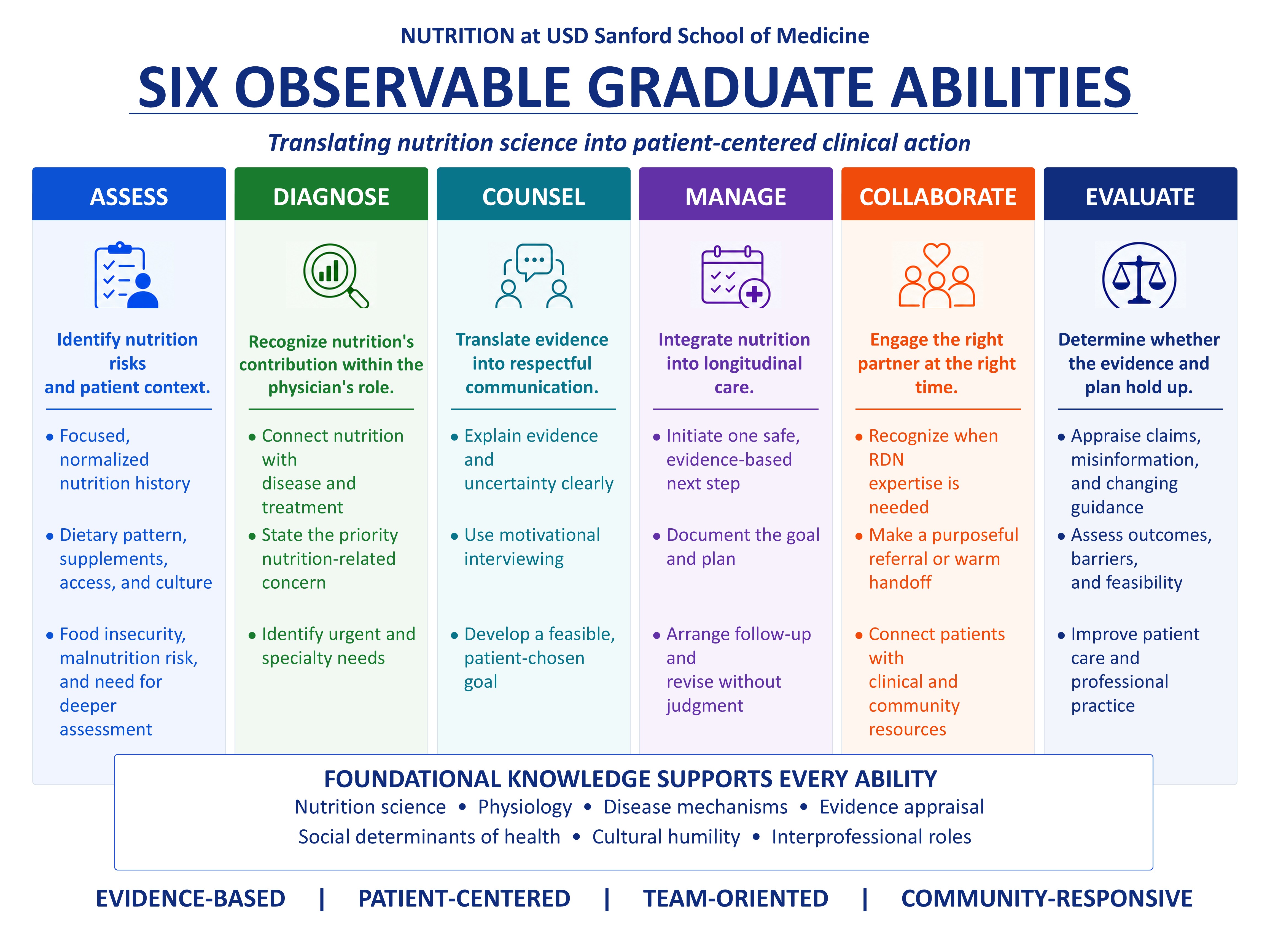
Six observable graduate abilities
Six observable graduate abilities The six abilities function similarly to Entrustable Professional Activities: each describes an integrated, observable unit of professional work that learners should increasingly perform with less supervision. Foundational knowledge is essential and is mapped beneath each ability.
| ASSESS | Identify nutrition risks, strengths, behaviors, access, and patient priorities. |
|---|---|
| DIAGNOSE | Interpret nutrition-related information and incorporate it into clinical reasoning. |
| COUNSEL | Communicate evidence clearly and support feasible, patient-centered change. |
| MANAGE | Integrate nutrition into treatment, monitoring, documentation, and follow-up. |
| COLLABORATE | Engage registered dietitian nutritionists and other professionals purposefully. |
| EVALUATE | Appraise evidence, address misinformation, communicate uncertainty, and revise recommendations. |
Evidence-to-Action learning cycle
Students revisit five developmental stages across the curriculum:
- Evidence — Learn and critically appraise foundational science and clinical guidance.
- Apply — Use evidence to reason through authentic patient problems.
- Practice — Rehearse conversations, decisions, documentation, and collaboration with coaching.
- Demonstrate — Show performance in cases, simulations, OSCEs, and clinical settings.
- Improve — Use feedback, reflection, and performance dashboards to set the next learning goal.
CARE: a practical script for nutrition conversations
CARE gives learners a repeatable structure—and usable language—for moving from nutrition evidence to an efficient, respectful clinical conversation. It supports focused assessment without turning every encounter into comprehensive dietetic counseling.
| C — CONTEXT | Understand the patient’s goals, concerns, culture, resources, and readiness. |
|---|---|
| A — ASSESS | Ask focused questions and identify the nutrition issue most relevant to today’s care. |
| R — RESPOND | Connect the findings to health, share evidence in plain language, and prioritize appropriate options. |
| E — ENGAGE | Develop a feasible shared plan, involve additional expertise when needed, and arrange follow-up. |
CARE is reinforced through role-play, standardized-patient encounters, telemedicine, oral case presentations, nutrition-focused SOAP documentation, clinical observation, feedback, and learner reflection.
Learning across four years
-
Foundation and evidence
Nutrition is integrated into biochemistry, physiology, and organ-system learning. Students learn to appraise guidelines, research findings, emerging therapies, and nutrition misinformation. -
Coached clinical application
Brief asynchronous preparation preserves live time for case-based reasoning, recurring patient scenarios, CARE scripting, motivational interviewing, documentation, referral decisions, and team-based practice. -
Demonstrated performance
Standardized-patient OSCEs, educational telemedicine OSCEs, oral case presentations, clinical documentation, referrals, handoffs, and workplace-based observations provide evidence of progress toward the six graduate abilities.
Core expectations, adaptable delivery
LCNC is intended to preserve common outcomes while allowing institutions to choose delivery methods that match local faculty, technology, facilities, clinical sites, and community needs.
- Modular cases, facilitator guides, shared rubrics, and faculty micro-guides reduce local development burden.
- Educational telemedicine OSCEs can use common institution-approved videoconferencing and breakout rooms rather than specialized platforms.
- Registered dietitian nutritionist expertise can be concentrated in curriculum design, faculty preparation, assessment, selected instruction, and complex cases.
- Interprofessional participation can expand according to available local partners; the core curriculum does not depend on every discipline being present.
- Culinary medicine and resource-intensive simulation can be added when they are educationally justified and equitably available.
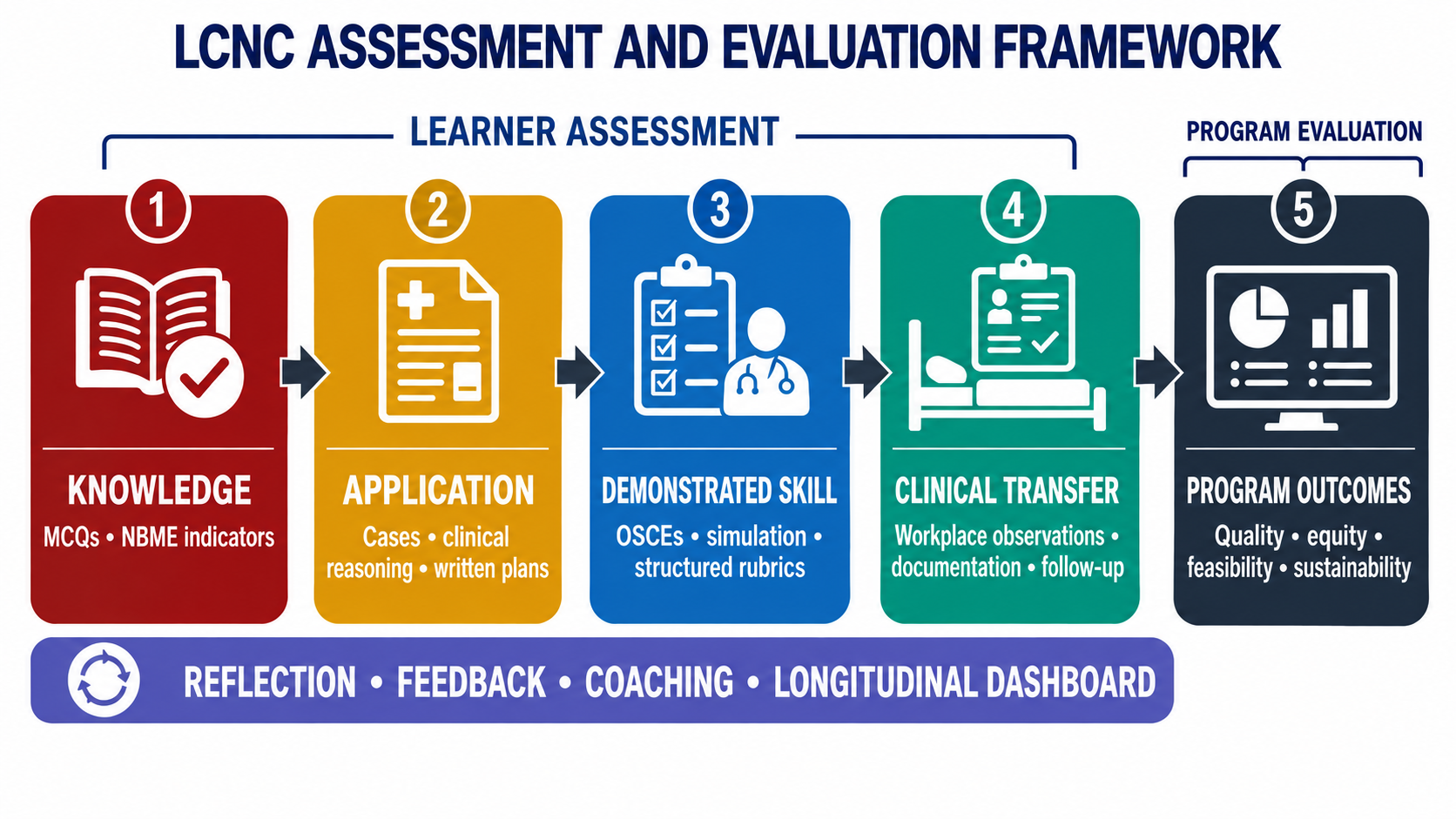
How we will know LCNC is working
LCNC aims to graduate physicians who can recognize nutrition-related needs, make sound clinical decisions, communicate evidence without oversimplification, initiate appropriate care, engage additional expertise, document and follow up, and improve through feedback.
Program evaluation will examine implementation across sites, clinical reasoning, developmental progression, transfer to patient care, feasibility, and adaptability. Shared rubrics and longitudinal dashboards are planned to make growth visible to students, faculty, and program leaders.
Designed for adoption and adaptation
Institutions could adopt the complete longitudinal model or begin with selected components—such as the six-ability framework, CARE scripting, active-learning cases, telemedicine practice, or developmental rubrics—and expand over time. The intended value is not a single prescribed format, but a coherent pathway from nutrition evidence to observable clinical performance.
Program development status
LCNC is a proposed curriculum currently being planned and refined by the USD Sanford School of Medicine Office of Medical Education and collaborating faculty and health professionals. Curriculum mapping, instructional materials, faculty preparation, assessments, implementation planning, and evaluation strategies remain under development.
Contact Us
For Questions about the proposed Longitudinal Clinical Nutrition Competency (LCNC)
Office of Medical Education
University of South Dakota Sanford School of Medicine
[email protected]
Amy Prunuske, PhD
Associate Dean of Medical Education
[email protected]
Roy Mortinsen, MD, FAAFP
Assistant Dean of Medical Education
[email protected]

Lifestyle Medicine
By embedding Lifestyle Medicine principles throughout medical education, the USD Sanford School of Medicine is preparing a new generation of physicians to advance the health of South Dakotans through informed, compassionate, and nutrition-focused care.
