
Advancing Care, Shaping Futures: Mentorship and Medicine With Dr. John Lee

This story was written by Ruby Haws, SSOM Class of 2027.
Throughout his career, he has been a trailblazer. Whether advancing new approaches to cancer treatment or working to reduce barriers to specialty care for patients in rural communities, he has become a model for both students and colleagues, demonstrating the value of persistence, adaptability and innovation.
His journey has spanned academic research, biotechnology leadership, tertiary surgical care, medical student mentorship and ultimately, a return to rural medicine in South Dakota. Across each stage of his career, it is the moments with patients that have stayed with him, shaping not only the path he built, but the way he now guides others along theirs.
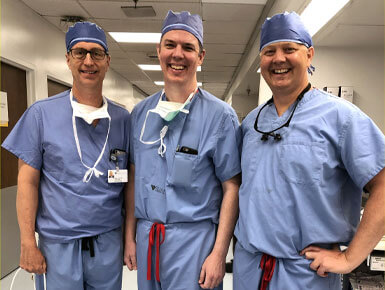
One of those moments came early in his career, shaping everything that followed. Lee recalls caring for a young man with cancer whose disease had recurred despite the best available treatments. Delivering the news that there were no remaining curative options was devastating, not only for the patient and his family but for Dr. Lee himself. Rather than accepting the limits of existing interventions, he became driven to push beyond them.
“It was at this moment I wanted to use my surgical, research and medical knowledge to develop and advance therapies that would not just prolong the cancer treatment but was aimed at truly curing it,” Dr. Lee shares. “To this end, all the parts of my path have had this in common.”
His work in research focused on understanding how cancer evades the immune system and how that system might be harnessed to fight back. Through developing models that more closely mimic human disease, his work contributed to the early stages of therapies that would eventually move into clinical trials. This was progress that unfolded over years, not just months.
That long timeline is something he emphasizes when mentoring students.
“One needs to realize many rewards are not always immediately gratifying,” he explains. “For instance, we developed a cancer treatment in the lab, then proved it worked well in animal models. It is currently in phase two trials in humans. This process took 10 years. The reward was not financial but rather realizing you could impact treatment.”
His commitment to pushing beyond limitations continues to shape how he approaches patient care. For him, research is not confined to the lab, but is a mindset carried into everyday practice.
“I feel research is critical to all aspects of patient care. It does not require a large lab or a lot of scientific experiments,” Dr. Lee shares. “It is staying involved in continued learning, reading others’ advances and staying current. Medical care is continuing to advance rapidly and staying active in researching the aspects that improve the care you give is critical.”
For Dr. Lee, these experiences are not just career milestones, they are lessons he can pass on. As a faculty member at the Sanford School of Medicine, he views mentorship as an essential part of being a physician.
“I feel educating and mentoring younger people in training is part of our oath,” he says.
But mentorship, in his view, is far from one-sided.
“While we hopefully do impact others with some of our knowledge, the act of educating and mentoring also helps us. I feel younger people continue to challenge us and keep us sharp by asking questions,” he adds. “I also feel that the generational process keeps one young at heart.”
That perspective is especially evident in his work with students in the Frontier And Rural Medicine (FARM) program. Students who rotate through Pierre quickly come to appreciate Lee’s approach to teaching. In both the clinic and the operating room, he creates an environment where students are not just observers, but active participants, encouraging them to think through decisions, engage with patients and build confidence in their clinical skills.
In rural settings where resources are often limited and distances between patients and specialty care is significant, the lessons extend beyond clinical knowledge.
“The experience teaches what can and should be treated locally,” Lee explains, “and the critical aspects of getting a patient to tertiary care center care when needed.”
These teachings reflect the realities of his own practice.
Today, Lee serves as the only ENT surgeon in Pierre and the surrounding 300 miles. After years in highly specialized, tertiary head and neck cancer surgery in Iowa City and Sioux Falls, the transition to rural medicine required both professional and personal adaptation. A physically demanding practice resulting in two spinal surgeries finally prompted the decision to return to a setting similar to where he grew up.
In doing so, he gained a renewed perspective on access to care.
“You also realize it is, in many instances, a burden to travel three to four hours for care,” he says. “You try to assist in care any way you can and collaborate with tertiary physicians.”
In rural communities, the physician-patient relationship also takes on a different dimension. Encounters extend beyond the clinic, and the responsibility of care is felt more continuously.
“The transition to rural care also means you interact more commonly with people you treat in the community. It also means you are on call for assistance whenever in town.”
It’s an environment that reinforces not only clinical decision-making, but the importance of communication, adaptability and trust–all qualities Lee emphasizes in his teaching.
He often draws on lessons from his own mentors who played pivotal roles in shaping his career. Early in his training, a physician-scientist who guided him through an NIH grant left a lasting impression, not only through technical expertise, but through generosity.
“What I really appreciated is that they gave help without having it help them. They enjoyed helping so that others succeeded. This altruistic approach really impacted me and I hope it has lasted as I help others,” Lee reflects. “It is a reward not always appreciated in our society.”
For students just beginning their careers, his advice is both practical and deeply personal: pursue what you love, even when the path is difficult.
“When you are doing things you love it does not seem like work,” he says. At the same time, he emphasizes the importance of maintaining balance in family, time away from medicine, and personal values as ways to sustain a long and meaningful career.
Now, after a career that has spanned disciplines and settings, what continues to inspire him is not just the work itself, but the people entering it.
“I am very enthused by younger people pursuing careers that make an impact,” he says. “I look forward to interacting with medical students and residents as they are forming or starting their careers. I hope that my questions and guidance can help them as they advance the field of medicine and will try to make an impact as long as my skills last.”
For students at the Sanford School of Medicine, his impact extends beyond the clinic. Through mentorship, example and a willingness to invest in the next generation, he continues to shape the future of medicine in South Dakota and beyond.
You May Also Like

Matthew Fairholm Named Director of the Chiesman Center for Democracy
The University of South Dakota Department of Political Science is pleased to announce Matthew R. Fairholm as the next director of the Chiesman Center for Democracy.

Rachel Barton Pine to Bring Centuries of History to Life in Concert at USD
Internationally acclaimed violinist Rachel Barton Pine will bring centuries of history to life in an unforgettable concert on Saturday, Oct. 17, at Aalfs Auditorium in Vermillion, South Dakota.

USD Sanford School of Medicine Receives Nearly $1 Million to Address Substance Abuse and Recovery
The Center for Rural Health Improvement at the University of South Dakota Sanford School of Medicine has received a $993,600, four-year grant to advance efforts to address health disparities associated with substance use disorders across South Dakota.
