
Haarberg 3D Center Awardee’s Journey to Advance Cancer Therapies

“I worked as an undergrad in a lab making solutions, using the autoclave, and stocking the tissue culture room. During my junior year, I started performing my own experiments,” she said. “And I remember thinking, wow, you can get paid to do this as a career!”
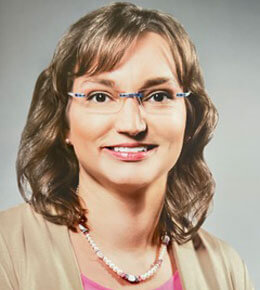
That excitement for lab work helped her earn a bachelor’s degree in biology from Washington University and a Ph.D. in molecular biology at the University of Iowa. She became a postdoctoral fellow at the National Institutes of Health, where she started her own research program developing immunotherapies and biomarkers for breast cancer.
In 2004, she came to Sioux Falls to start the Cancer Biology Research Group at the South Dakota Health Research Foundation, now Sanford Research, and joined the SSOM that same year as an assistant professor in the Department of Obstetrics & Gynecology. From there, she trained many students from research internships through master’s, Ph.D. and M.D. programs. Over the following years, Egland was promoted to associate professor at the SSOM.
But it was a much more personal experience that would ultimately reshape her career and lead her down the path to the work that recently earned her a grant from the Haarberg 3D (Drug, Disease, and Delivery) Research Center.
Life Happens
Egland had already built a career studying cancer when cancer found her.
“I noticed that there was a lump in my breast,” she said. “It turned out to be a 4 cm tumor.”
At just 37, with two young children, she was diagnosed with triple-negative breast cancer, an aggressive form of the disease. Unlike other types of breast cancer, it lacks the three most common targets for drug therapies, limiting treatment options.
“So, I had a cancer that just rapidly grows,” she explained.
Her treatment was equally aggressive: a bilateral mastectomy, eight rounds of chemotherapy, and six weeks of radiation.
“It was… it was awful,” she said.
The experience reinforced something she already knew from her research but now understood on a deeply personal level. While treatment is possible if the cancer is caught early, what needs to be done to increase chances of a cure or survival can be devastating.
Rather than stepping away from science after her diagnosis, however, Egland leaned in, reshaping her work to focus more directly on research that would improve the lives of patients.
“I decided that I was done doing basic research, just figuring out the function of a single protein,” she said. “I wanted to do translational research and have a more direct impact on patient care, prognosis, and quality of life.”
The SSOM is what made that shift possible.
“I developed patient consent forms and protocols for my clinical research, served on the Sanford IRB and attended Tumor Board regularly, which put me in the room with physicians and clinical research staff,” she said. “I also published two research articles with an oncologist at Sanford Health in Fargo, North Dakota. Access to patient samples and to physicians’ input is an invaluable resource, and it is not something a laboratory can generate on its own.”
The SSOM also shaped Egland’s commitment to medical education. For her, training students has been one of the most meaningful parts of her career.
“Seeing students I trained now practicing at Sanford Health is my clearest reward,” she said.
“As the medical school transitions Pillar 1 to Sioux Falls, I look forward to developing new relationships in real time,” she said.
After recovery, Egland’s work at Sanford Research turned toward molecular pathology, cancer biology, and immunotherapy. She then took a turn at SAB Biotherapeutics, a biotech company in Sioux Falls, where she served as executive director of drug discovery and genetic innovation.
Making New Plans
Egland and her collaborator, Thomas Luke, M.D., decided to sharpen their focus and launch their own company, Poly Solutions, to develop therapeutics for cancer and infectious diseases.
Their goal is to develop new kinds of cancer therapies that are more adaptable and potentially more effective than current treatments.
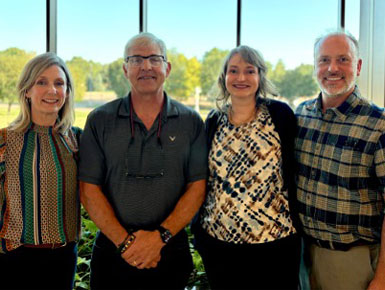
According to Egland, most current antibody therapies rely on monoclonal antibodies, which target a single marker on a cancer cell. But tumors evolve, and single-target treatments can stop working. The work of Poly Solutions is to change treatment by developing an approach inspired by how the human immune system naturally works.
Egland offers a simple analogy.
“Let’s say that a Christmas tree represents a protein, and the monoclonal antibody binds to the star on top of the tree,” she said. “The polyclonal antibodies target and bind to the lights. They’re all around the tree.”
If the star on top of the tree burns out, the monoclonal antibody can no longer recognize the target. But the lights, spread across the branches, still shine.
“Once the target gets mutated, monoclonal antibodies no longer work,” she said of single-target therapies. “But with the polyclonal therapies, there’s still plenty of shinning lights that can be bound.”
Egland’s current research focuses on developing polyclonal antibodies to fight multiple myeloma, a blood cancer that presents clearer entry points for immune-based treatments.
For Egland, effectiveness isn’t the only goal, however. Alleviating the harsh side effects of cancer treatment is also important.
“Antibodies, in general, have much lower side effects than chemotherapy,” she said.
Next Steps
Today, Egland and her team are working to move their discoveries toward clinical trials, supported by early-stage grant funding and growing infrastructure. While she is careful not to promise too much, her optimism is clear.
“I really think polyclonal antibodies are the key to make a difference in the lives of cancer patients,” she said. “I’m so ready to make this therapy available as an option for treatment.”
About the Haarberg 3D Center
The Haarberg 3D Center, established in 2021 and housed at South Dakota State University, focuses on advancing drug development through integrated research and collaboration. It aims to build the infrastructure, partnerships, and networks needed to translate and commercialize new treatments for cancer and other diseases. The center brings together multidisciplinary strengths in drug, disease and delivery research from South Dakota State University, the South Dakota School of Mines and Technology, and other academic, clinical and industry partners. It was established by a $1.1 million gift from Kevin and Lorie Haarberg and five-year, $3.9 million award from the South Dakota Research and Commercialization Council.
You May Also Like

Martial Music: USD Alumnus Brian Mann and Service Through Song
Founded in 1931, the University of South Dakota College of Fine Arts has long represented hope, inspiration and the power of the arts as a catalyst for change that spans across state lines.

USD Kinesiology and Sport Management Students Apply Learning Through Community Partnerships
For students in the University of South Dakota’s kinesiology and sport management program, learning about exercise intensity and program design goes beyond the classroom.

USD Gives Insight Into Developing Programs
On Thursday, Sept. 17, University of South Dakota President Sheila K. Gestring delivered the 2026 State of the University address. Gestring shared the past year’s achievements with gathered faculty, staff, students and the public.
