
From Passion to Impact: Center for Digital Accessibility Removes Barriers Across South Dakota

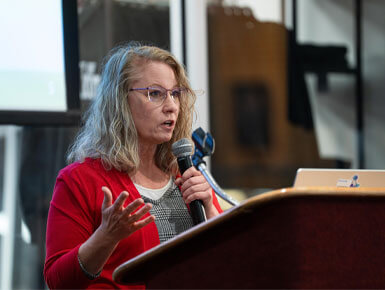
Angela Jackson, Ed.D., is the director of the USD Office of Accessibility and a master’s (2006) and doctoral (2023) graduate of the USD School of Education. She is now also the director of the new Center for Digital Accessibility, an innovative office revolutionizing access to digital materials across South Dakota.
Launched in the fall of 2025, the center provides services to help organizations comply with new accessibility standards set to go into effect this coming April with Title II of the Americans with Disabilities Act. South Dakota Board of Regents member institutions are among the organizations subject to these requirements, and many of them do not have the resources to update their digital accessibility practices.
Jackson shared that prior to the establishment of this center, there simply were not in-state options for supporting compliance.
“You have to have qualified people doing this work,” Jackson said. “They have to be certified, and I’m the only certified accessibility professional in the state. My colleague will be the second. Our goal is to really ignite a groundbreaking statewide initiative harnessing cutting-edge technology to build a powerful resource hub with digital accessibility solutions for higher education,” Jackson continued.
Those solutions include evaluation of digital spaces, text-to-speech resources, strategic planning for digital accessibility, expert training, document remediation and more. The center aims to accelerate South Dakota higher education institutions’ compliance with Title II regulations, ultimately limiting barriers for student success.
In addition to aiding SDBOR institutions, Jackson foresees the center supporting the implementation of cutting-edge technology across the state. “This is a transformative project to help position South Dakota as a national leader in digital accessibility.”
Leading by Example
A few years ago, when trying to find certified organizations to review the USD website for accessibility, Jackson was calculating the cost at an eye-watering half a million dollars. With no in-state organizations offering this service, she immediately said, “Why don’t we create one? Why don’t we just create a service center that can not only serve USD, but that can also provide these services to the whole state of South Dakota?”
The center is set to support K-12 schools, state agencies and local government offices within the state at affordable prices, subsidized by providing expert review of digital accessibility for private organizations.
As the only certified expert on digital accessibility in South Dakota, Jackson invited USD to invest in certifying future accessibility experts within the state. USD made that investment a priority, and the center is currently expanding its infrastructure to meet state needs for accessibility support.
With this investment in staff development, South Dakota is set to become a national leader in accessibility. Jackson anticipates that this center will become a model for other states to emulate.
The center goes beyond what AI-powered accessibility checkers can provide, with expert consultants and human tests. Eventually, Jackson hopes to hire people with disabilities—including USD students—to examine the accessibility of digital materials and apply their strengths and experiences to broaden statewide access to important services. For now, experts test how responsive and compliant materials are by emulating the experiences of blind, deaf and otherwise disabled users.
To make sure the center is responsive to varied needs, Jackson is creating an advisory board composed of professionals from across South Dakota. Ryan Angelo, ’16, ’12, the interim chair of the advisory board, is the director of integrated marketing at Sanford Health, as well as a two-time graduate of USD. He has spent his career working on digital marketing, with a particular focus on accessibility that has prepared him to offer valuable insights in this initiative.
“I feel honored and privileged to be able to give this time back to USD,” Angelo said. “Yes, I’m giving back to USD, but USD is also giving back to an underserved community… by providing services for these underserved populations that need access, that need fluid experiences digitally, just like I would have.”
For Jackson, the importance of that mission hits close to home. Her own experiences have inspired her career in accessibility and her work to make a difference in the lives of students.
Turning Personal Experiences Into Impact
After suffering a traumatic brain injury in 2006, Jackson struggled to learn and engage the way she was used to. She had to re-learn how to speak and eventually was diagnosed with a learning disability.
“Learning became very different for me,” Jackson said. “I couldn’t rely on my vision anymore and became a much stronger auditory learner. I struggled for a long time trying to figure all that out.”
Even with an accommodation, the resources for converting text to audio simply did not exist when she was a student.
But Jackson isn’t one to see a problem and let it lie. As she began to research this issue, she connected with students across campus who also could not access their materials.
Eight years ago, as a Center for Teaching and Learning professional, she proposed an opt-in digital accessibility initiative to promote proactively designing issues that students with disabilities faced. Now, she’s extending that project by establishing a self-sustaining office that proactively supports institutions in developing accessible digital content.
A Community of Support
From her years working to create a culture of actively addressing the needs of individuals with disabilities, Jackson developed the expertise, connections and inspiration that sparked the new Center for Digital Accessibility.
If you ask her, though, she’ll laud the praises of everyone who supported her along the way.
“I’m a person who has a disability and I’m living this. I feel a lot of gratefulness and appreciation for all of the people that helped make this happen, because it really wasn’t me,” Jackson said. “Honestly, it was the people who believed in me, who believed in this initiative, who really got behind me and helped me, who opened up the doors and gave me the opportunity to sit at the table to develop these ideas and resources.”
Jackson stresses that the students are the greatest benefactors of the center’s work. She notes that, with three quarters of USD students using mobile devices to access their courses, “it’s for our students with disabilities, but ultimately, it’s benefiting all of our students.”
The new Center for Digital Accessibility, launched and propelled by Jackson’s digital accessibility expertise, provides benefits to USD students and people with disabilities across the state, and establishes South Dakota as a nationally competitive resource for digital accessibility.
You May Also Like

Dr. Tim Ridgway Named to AAMC Council of Deans Administrative Board
The University of South Dakota Sanford School of Medicine has announced that Dr. Tim Ridgway, ’84, dean of the Sanford School of Medicine and vice president for the Division of Health Affairs, has been elected to serve on the Association of American Medical Colleges Council of Deans Administrative Board.

USD Opera to Present ‘The Light in the Piazza’
The University of South Dakota Opera presents "The Light in the Piazza," with orchestra, on May 2 at 7:30 p.m. and May 3 at 3 p.m. in Aalfs Auditorium inside Slagle Hall on the Vermillion campus.

USD Students to Present ‘Down on Main Street: Part of Vermillion’s Story Through Time’ on April 21
The University of South Dakota’s Department of Anthropology and Sociology, in partnership with the Anthropology Program Enthusiast Society student organization, presents “Down on Main Street: Part of Vermillion’s Story Through Time” on Tuesday, April 21, at 5:30 p.m. at the Coyote Twin Theater in Vermillion, South Dakota.
