A Week of Service and Learning for USD Undergraduates in Guatemala

The group was led by Liz Hanson, Ph.D., associate professor in USD’s Department of Communication Sciences and Disorders, who said the trip provides students with hands-on experience in a setting where economic constraints and geographic isolation can affect access to healthcare.
“We emphasize that we’re going there to learn, to teach and to share,” Hanson said. “It’s not that medical services in the U.S. are better and we’re trying to save everyone. We are forming reciprocal relationships and partnerships with other professionals, clients and families.”
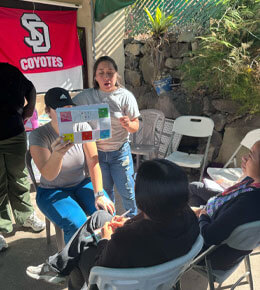
The trip was coordinated and hosted by ADISA, an organization based in Santiago Atitlán that supports children with disabilities and their families in communities surrounding Lake Atitlán. USD students performed clinical services—speech, language, and hearing screenings and blood pressure and heart rate measurements—for 60 Indigenous children in five Mayan communities surrounding the lake.
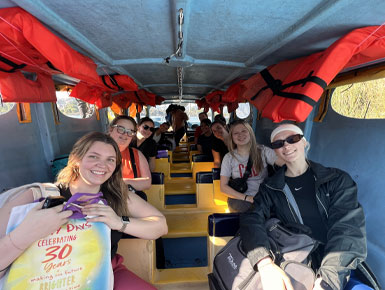
Hanson has worked with ADISA on all four faculty-led programs she has either led or co-led to Guatemala. The organization provides translators who speak English, Spanish and other Mayan languages spoken in the remote mountainous region where the clinics were held.
Students who participated in the program include nine majoring in communication sciences and disorders and two students with medical biology majors. In preparation for the trip, the group held weekly sessions exploring Guatemalan history, healthcare, language, and culture. These meetings also addressed essential logistics, including passport requirements, currency exchange, and safety protocols.
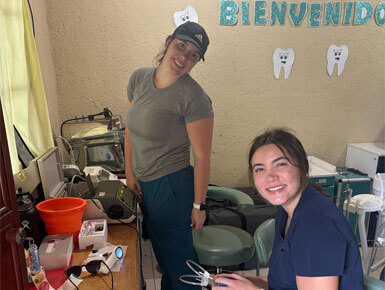
In past years, Hanson has made similar service-learning trips to Guatemala along with colleagues and students in USD’s physical therapy and occupational therapy departments. This year, so many students expressed interest in the experience that each of the three departments took separate trips.
“All three programs emphasize experiences like this to learn about other cultures, other healthcare systems, and other ways of doing things,” Hanson said about the program’s popularity. “It’s also a time in a student’s life when they can travel and experience something new and different with a lot of support.”
Ariana Edwards, a student from Sioux Falls triple majoring in medical biology, Spanish and neuroscience, enrolled in the program for an opportunity to study abroad while still an undergraduate. Since her demanding major requirements prevented her from traveling in another country for a full semester, the weeklong Guatemala program offered an attractive alternative.
“I realized this was the perfect opportunity to get to practice Spanish in a medical setting and learn more about two of my biggest passions,” Edwards said.
“My Spanish absolutely helped me,” she added. “I was able to connect with patients better than if I had not been able to speak with them. At one point I met a doctor who only spoke Spanish and I got to learn so much more about the healthcare system in Guatemala, a chance that I would not have had without that language.”
It was the first time traveling abroad for two students on the trip.
Morgan Meyer, a communication sciences and disorders major from Rock Rapids, Iowa, enrolled in the program to enhance her experiences outside of the classroom.
“I’ve been wanting to travel internationally, and this opportunity allowed me to,” she said. “I really enjoyed traveling somewhere new and helping others with something I am so passionate about.”
Meyer’s favorite parts of the trip were her interactions with the children. One young girl who stood out hadn’t experienced much social interaction when she was little, according to her teachers.
“Getting to work with her in the hearing screenings brought me so much joy because you could tell in her face when she finally understood the task we were asking her to complete,” Meyer said.
Haley Zakovec also experienced her first time abroad on this trip. The communication sciences and disorders major from Morse Bluff, Nebraska, also minors in deaf education and child and adolescent development.
“My favorite part of the trip was on one of the first days when we went to a school. As soon as we got out of the van, all the kids ran up to us and gave us hugs. They were so happy we were there,” Zakovec said. “The most surprising part was that we sometimes needed two translators because some of the kids spoke different Mayan languages.”
Besides learning about a new culture, Zakovec said the trip also made her more eager to embark on a career in speech language pathology.
“I was excited to experience a different culture while also using what I’ve been learning in class in a real-life setting. We did a lot of hands-on work, including hearing and speech screenings with kids,” she said. “This trip helped me realize that this is the right career for me.”
You May Also Like

USD’s Master of Public Health Program Achieves Reaccreditation
The University of South Dakota and South Dakota State University’s joint Master of Public Health (MPH) program has been granted reaccreditation for a seven-year term, the maximum given, by the Council on Education for Public Health (CEPH).

SPURA Students Present at 2026 Eastern South Dakota Undergraduate Research Symposium
Eight undergraduate researchers participating in the University of South Dakota’s Summer Program for Undergraduate Research in Addiction (SPURA) finished a productive summer of research by presenting their work at the 2026 Eastern South Dakota Undergraduate Research Symposium.

USD Knudson School of Law Alumni Honored With 2026 Unleash Your Legacy Awards
Two distinguished alumni of the University of South Dakota Knudson School of Law were recognized as recipients of the 2026 Unleash Your Legacy Alumni Achievement Awards, celebrating their exceptional professional accomplishments, leadership and commitment to serving others.
