
Isabella Rabac Wins GSA Peter Birkeland Award for Graduate Student Research in Soil Geomorphology

Rabac, who is a teaching and research assistant in the USD Department of Sustainability and Environment, received the award in mid-October at the Geological Society of America meeting in Denver.
“I was extremely excited and honored to receive this award,” said Rabac. “It feels really wonderful to have my research recognized by the Quaternary Geology and Geomorphology Division of the Geological Society of America, and I am incredibly grateful for this opportunity and all who have helped me get to this point.”
Because most Dust Bowl research focuses on the Southern Great Plains, Rabac has chosen to focus her graduate thesis research on the Northern Great Plains and how different soil properties (texture, structure, crust strength, etc.) influence the dust emission process in the Northern Great Plains.
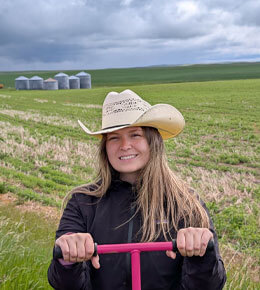
Her research for the GSA Peter Birkeland Award also focuses on similar areas.
“My GSA Peter Birkeland Award research investigates which factors are most influential to soil aggregate formation in the Northern Great Plains. I like to tell students that soil aggregates are like balls of cookie dough. You can think of the ingredients as sand, silt, clay and organics, which all come together to form very small balls, known as soil aggregates,” said Rabac. “When soil aggregates break apart in a process known as aggregate disintegration, the individual particles (or ingredients) are small and much more susceptible to erosion by wind and can in turn, become potent sources for dust emissions.”
Rabac plans to investigate this part of her research by testing the emissivity of soil aggregates from all across the Northern Great Plains and testing the soil’s bulk density, soil moisture, organic matter content, carbonate content, salinity, particle size, carbon, nitrogen and cation exchange capacity.
“Both my graduate research and my GSA Peter Birkeland Award research are important in their own respective ways,” said Rabac. “My research is important because it can help us better understand and quantify the 1930s Dust Bowl and potentially be used to inform future decisions regarding land use in the Plains and beyond. The GSA research is significant because it has the potential to reshape the way we view aggregate disintegration and sources of dust in the Northern Great Plains.”
Through it all, Rabac credits her USD team—specifically Mark Sweeney, Ph.D., professor in the Department of Sustainability & Environment, and Joe Kantenbacher, Ph.D., coordinator of graduate programs and assistant professor in the Department of Sustainability & Environment—and the university for influencing her research and career goals.
“I have really enjoyed sharing my knowledge with my fellow graduate students and learning about their research,” said Rabac. “I love the collaborative environment we have in our offices and my teaching experience has helped me solidify my goal of staying in academia. The community and faculty at USD are always willing to help, on campus and beyond.”
About the Peter Birkeland Award
A generous gift from Peter Birkeland established the Peter Birkeland Soil Geomorphology Award in 2016 to contribute to the advancement of soil geomorphology. The purpose of the award is to support promising M.S. and Ph.D. graduate students working on a thesis with a research focus in soil geomorphology. The award may go to a student doing research in the general field of weathering, Quaternary stratigraphy, or geomorphology. The division granted the first Birkeland Award in 2017.
You May Also Like

USD School of Education Awards Four Individuals With Legends of Delzell Award
The University of South Dakota’s School of Education awarded four distinguished individuals with the 2026 Legends of Delzell Award on Oct. 15, recognizing their lasting contributions to education, leadership and the campus community.

USD College of Arts & Sciences to Host 2026 Pillars of Distinction Awards Night and Hall of Fame
The University of South Dakota College of Arts & Sciences will host the second annual Pillars of Distinction Awards Night and Hall of Fame on Friday, Nov. 13, 2026, from 6 to 9 p.m. in the Muenster University Center Ballroom on the USD campus in Vermillion, South Dakota.

Legal Learning: South Dakota Supreme Court Convenes at USD
The South Dakota Supreme Court travels through the state twice a year to hear oral arguments at public institutions, giving the public an opportunity to observe the court in action. Each year, the court holds one of their sessions at the University of South Dakota Knudson School of Law.
