
USD and the South Dakota Discovery Center Host Workshop for South Dakota Teachers

Throughout the day, educators experienced science lessons as their students would, collaborated with university faculty and provided feedback on the curriculum. The workshop introduced educators to curriculum modules developed through Anderson’s National Science Foundation-funded research, which translates university research into engaging, classroom-ready lessons that encourage new approaches to teaching biology, physics, engineering and physical science. At a later date, the curriculum will be made freely available to educators statewide.
“We want to communicate in a way that engages students and keeps them interested and learning,” Anderson said.
During the workshop, doctoral students introduced the visiting educators to two chameleons, a common species from the Middle East but introduced previously to Florida and Hawaii, and a South African dwarf chameleon.
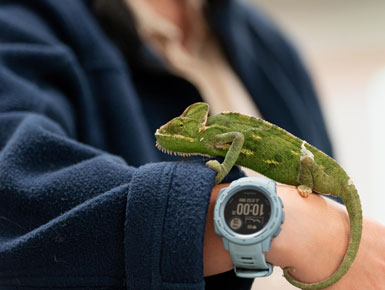
Anderson and his graduate students utilize high speed cameras while feeding the reptiles. By analyzing these recordings, the researchers develop new knowledge about their tongue muscles, hydration methods, bite force and skin structures. “They have such unique and accentuated features that really make them interesting to learn about,” he said.
After hearing Anderson’s research presentation, educators participated in hands-on examples of student lessons such as using springs, string and cat toys to replicate the mechanics of a chameleon’s tongue and measure the efficacy of its catch.
The research goal is to find teaching systems that are exciting, appealing and visually interesting for students, as well as increase student engagement from elementary school to graduate work. By bringing a subject that seems exotic and untouchable to the classroom, educators can expose rural students to the research taking place close to home and spark the initial interest that may flourish into a lifelong passion for STEM.
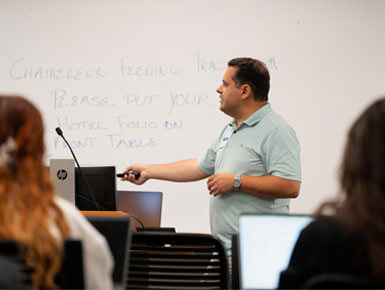
Hands-on experiments encourage students to collaborate and explore instead of seeking one “correct” answer while teaching them to make and develop useful observations. Classroom experiments with the scientific method also prepare students for collegiate scientific research and a lifetime of real-world problem solving.
“It’s not just something that’s theoretical, that’s just happening somewhere out there in the ether. This is something that’s happening in South Dakota, and the students can know it’s happening in the real world,” said Anne Lewis, the executive director of the SDDC.
One educator attending shared that she enjoys teaching novel subjects like live animals because she gets to serve as a physical bridge between students and the subject. At the end of the day, educators took home kits of materials so they could recreate the experiment with their students, creating a direct link between university research and classroom activities.
By connecting cutting-edge university research with classroom instruction, the workshop demonstrated USD's commitment to supporting educators through continuing education, collaboration and faculty expertise while expanding STEM learning opportunities for students across South Dakota.
You May Also Like

Legal Learning: South Dakota Supreme Court Convenes at USD
The South Dakota Supreme Court travels through the state twice a year to hear oral arguments at public institutions, giving the public an opportunity to observe the court in action. Each year, the court holds one of their sessions at the University of South Dakota Knudson School of Law.

USD Professor Tom Mrozla Wins National Teaching and Mentorship Award
Thomas Mrozla, Ph.D., associate professor of criminal justice and the criminal justice program coordinator at the University of South Dakota, has been honored with the American Society of Criminology Division of Policing Teaching and Mentorship Award.

USD’s Master of Public Health Program Achieves Reaccreditation
The University of South Dakota and South Dakota State University’s joint Master of Public Health (MPH) program has been granted reaccreditation for a seven-year term, the maximum given, by the Council on Education for Public Health (CEPH).
