USD Archaeology Students Dig Into Field Work

The Bear Butte Creek Historic Preserve is an 180-acre site that includes Native American cultural artifacts and the historic remains of Fort Meade. Fort Meade, originally known as Camp Sturgis, is a former United States military post located east of Sturgis, South Dakota. Active from 1878 to 1944, the fort was a key institution in the history of the Dakota Territory and inspired an ecosystem of support systems in the nearby area.
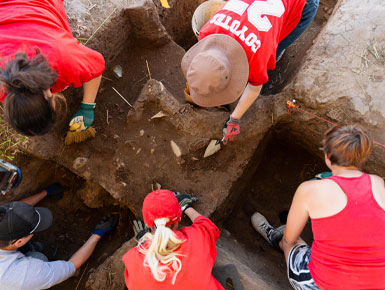
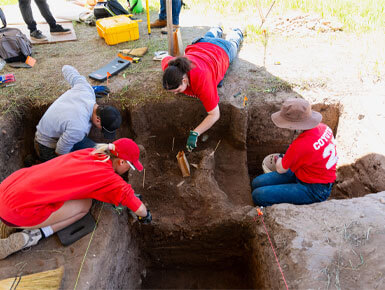
This year marks the third annual trip USD archeology students have taken to Fort Meade to explore its historic “Soap Suds Row,” the living area of Army laundresses, whose contributions to military life have been overlooked historically. The students are researching artifacts connected to the laundresses and their families who, along with unofficial duties such as preparing food and watching children, cleaned the uniforms of soldiers stationed at the nearby Fort.
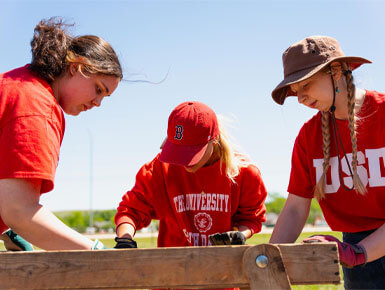
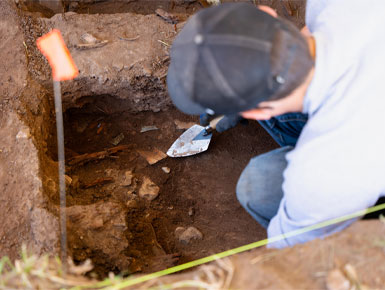
Approximately 34 students have participated in the Fort Meade field school over the past three years. The digs have uncovered numerous artifacts while providing hands-on archeological training for students. “A big part the appeal of this project is that this training can’t be done in a classroom,” Krus shared.
“Students who’ve participated in field school have gone on to pursue archeology at the graduate level. A number of students who have taken the course have also received a full-time positions working in anthropology and archeology,” Krus said. “It’s rewarding to see students take what they’ve learned here and turn it into successful careers.”
This year’s trip resulted in approximately 200 bags of artifacts, containing everything discovered in the ground that was human-made. A given bag could hold anything from one large artifact or dozens of tiny ones, such as the shards of a broken glass bottle. These artifacts are all transferred to USD after the excavation for further study in the new USD Archaeology Laboratory (ARCHLAB). After studying and cataloging, the objects are ready for curation in the state’s Archeological Research Center in Rapid City.
Undergraduate work study students and volunteers work with Krus on the archaeological cataloging process.
“The process of cataloging involves not just cleaning the artifacts but also figuring out what they are,.” Krus said. “After finding a scrap of metal, it might be easy to just say ‘Well, this is a metal scrap, we don't need to know anything else,’ but it’s in the process of researching machinery and appliances from the period that it could become something quite interesting. Last year, we had a scrap of metal which we identified as a likely alarm clock fragment.”
In the new ARCHLAB, USD undergraduate students carefully clean the artifacts with special soft brushes and picks, then research what they may be. This field and lab experience helps the students develop the skills necessary for their work that can’t be replicated in the classroom. Krus shared, “I often say in class that the excavation is just the start. It’s just the tip of the iceberg, because there's so much research and writing that has to be done in the ARCHLAB after we return from the field.”
Avery Welte, a sophomore majoring in anthropology and history, first became involved with the USD ARCHLAB after taking Krus' Introduction to Archaeology class last fall. She later joined the Anthropology Program Enthusiasts Society (APES), which allowed her to utilize the space outside of class, as the group hosts artifact cleaning nights in the lab.
“I have learned so much from the hands-on approach to archaeology, and I think that the new lab space is an optimal location for students to do so. It has also prepared me for what to expect in my future career, as I hope to become an archaeologist one day,” Welte said.
Anthropology major Natalie Wager called the ARCHLAB and Sturgis field school “one of the biggest blessings in my time at USD.” Wagner also presented information learned at Soup Suds Row at a conference, demonstrating how the project helps involved students add graduate-level research to their resumes.
Discoveries made during previous excavations at Soup Suds Row include fragments of cosmetic bottles, buttons, shoe fragments, pieces of ceramics, horseshoes, machinery and more. Most of the diagnostic artifacts (artifacts with specific, recognizable features that allow them to be easily dated) are from the 1890s or early 1900s.
“These items help humanize the people who lived and worked here,” Krus said. “They provide insight into their routines, personal lives and families.”
During next summer’s trip, Krus and his students plan to take samples from various other sites for comparison. Student interns surveyed approximately 160 acres of land and identified 20 new archeological sites of interest for future archaeological work. Krus plans on continuing the work on the site for the foreseeable future and thanked Historic Deadwood and the Black Hills Community Foundation for their continued support for this project of unearthing South Dakota history.
You May Also Like

Avera, SDSU and USD Sanford School of Medicine Establish Statewide NIH Research Partnership
The National Institutes of Health awarded $11,090,204 over five years to establish the South Dakota Center for Advancing Clinical and Translational Research (SD-ACT), a statewide partnership among Avera Research Institute, South Dakota State University and the University of South Dakota Sanford School of Medicine.

USD Philosopher Joseph Tinguely Awarded John Templeton Foundation Grant
Joseph Tinguely, Ph.D., was recently awarded a grant from the John Templeton Foundation in the amount of $435,790. This grant will support him as he organizes interdisciplinary collaborators with the aim of producing a conference, an edited manuscript and a series of public-facing media.

Educators Rising Day Welcomes Future Educators, Inspires Next Generation
The University of South Dakota welcomed approximately 150 high school students from 12 schools across South Dakota and Nebraska on Sept. 23 for Educators Rising Day, an event designed to introduce students to careers in education and help them explore their future as teachers, leaders and advocates.
