Sowing Solidarity: How FARM Students Are Giving Back Through Community Projects

This story was written by Rebecca Hofer and Ruby Hawks, SSOM Class of 2027.
“I’ve been the physician coordinator at the Parkston FARM site since the program was founded 12 years ago,” he explains. “The community project has been a component of FARM since its inception.”
Each year, 12 students spend their year-long, longitudinal clerkship across seven rural communities in South Dakota through the FARM program. Selected just four months into their first year of medical school, these students have a passion for rural healthcare and a dream to serve South Dakotan communities.
“The Community Project Initiative gives students the opportunity to formulate a project and potentially do some research, depending on what kind of project they choose,” Wickersham explains. “It also allows the students an opportunity to contribute in a meaningful way to their communities.”
From high school education initiatives to pregnancy loss memorial walks, no idea is too complex for a community project. At their core, these efforts reflect student passion and persistence, overcoming challenges to cultivate connection within rural healthcare.
Taking it to the Town
From the moment FARM students enter their sites, the clock is ticking to plan and execute their projects. Through a flurry of emails, phone calls and local conversations, these projects emerge as opportunities for students to connect with their host communities beyond the clinic walls.
“Community members get to interact with the medical students,” Wickersham says. “Every project is different, but no matter what the project ends up being, it always benefits the community in some way.”
Lucas Goetz, Milbank FARM student in the Class of 2027, took his passion for dermatology and preventative care to the cheese production factory in Milbank, creating a project that focused on providing skin cancer screenings for workers who rarely access dermatologic care.
“We did six on-site visits,” he explains. “I invited the factory workers to complete a survey about sun-exposure, sun-protection habits and dermatologic history, followed by a brief skin screening and education about skin cancer warning signs and self-skin examinations.”
Through this outreach, Goetz says he gained a clearer understanding of the barriers rural patients face when accessing specialty care.
“One thing that stood out to me was how interested many workers were in learning about their skin health once the conversation started,” he shares. “Many participants told me they had never seen a dermatologist before and had never been shown how to check their own skin.”
For Pierre FARM student Alison Kohler, Class of 2026, connecting with community members meant navigating the red tape surrounding the South Dakota Women’s Prison in Pierre and the revolutionary mother-baby unit. The Parents And Children Together (PACT) House is an initiative that allows low-risk, non-violent offenders who were pregnant at the time of incarceration the opportunity to maintain custody of their babies while in prison. During her time there, Kohler witnessed the women she worked with gradually open up, emphasizing the importance of trust and rapport between physicians and patients.
“I was able to form relationships with the women and children, provide educational and emotional support for the women,” Kohler explains. “Over time, the women become more comfortable with playing a role in their healthcare. They asked me other healthcare-related questions and, at times, inquired about how to approach a certain subject with their doctors. This was a community that I observed being very nervous and passive during their medical encounters, and seeing them become more interactive and empowered with their healthcare was a win.”
Together, these projects highlight how stepping beyond traditional clinical settings allows students not only to deliver care, but to better understand the contexts that shape their patients’ experiences.
Clearing the Back 40
Another learning curve students must face is overcoming logistic and financial barriers as they orchestrate their projects. While the needs are sometimes obvious, the methods are complex and the resources are sparse.
For students like Holly Gerberding and Bailey Smith, both Class of 2026, these barriers stemmed from cost and communication between multiple federal and statewide institutions. Both Gerberding and Smith were interested in sexual health and helping vulnerable populations at their FARM site in Winner. Together, they developed a cost-effective HIV/syphilis point-of-care screening project, targeting high-risk populations. Screening 112 individuals at the local jail, they identified seven positive cases, who later completed confirmatory testing, disease staging, contact tracing and treatment.
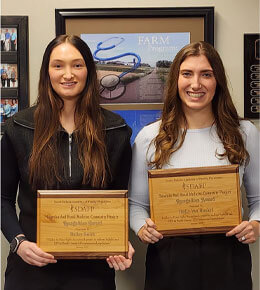
“We encountered several significant barriers, primarily related to cost and logistics,” Gerberding recounts. “Because individual counties are responsible for covering the healthcare expenses of incarcerated individuals, we needed to collaborate closely with local law enforcement to secure approval for funding the testing and treatment of participants who consented.”
Addressing these barriers required creative solutions, particularly when it came to money. Initially, the clinic’s standard protocol required sending blood samples for testing, costing almost $200 per collection. To address this, they partnered with the state laboratory and reduced the cost to $16 per vial.
“Eventually, we were able to provide screening services at no direct cost to participants and at a reduced cost to the appropriate government agencies,” Gerberding shares.
While Gerberding and Smith navigated financial hurdles, Kohler faced a different kind of barrier: the rigid infrastructure of the state correctional system.
“There was a lot of administrative clearance that had to be done in order for me to gain weekly access to the prison,” she says. “Some activities that we planned didn’t end up working out due to restrictions about what can enter the prison. I was just patient and tried to help cooperate with the prison administration to streamline the process as much as possible.”
As students learn to overcome these barriers and navigate what can feel like rough terrain, they build skills in resilience and creativity–skills that will help them in their future as physicians.
It Takes a Village
For many students, the projects they envision could not be possible without the help of local and statewide leaders. While the Community Project Initiative allows students to explore their own passions and ideas, it also presents the chance to offer a sustainable, long-term intervention through collaboration.
Gerberding reflects on her experience working alongside the South Dakota Department of Health and local law enforcement with fondness, remarking that the relationships she built were key to implementing the project, making the experience both professionally and personally rewarding.
“The jail’s medical staff was highly supportive and played a critical role in advocating for the project with jail administration. Their enthusiasm and cooperation were instrumental to our success,” she adds.
For Goetz, overcoming language barriers at the cheese factory necessitated recruitment of a community translator to ensure Spanish-speaking employees could participate and fully understand the education and screening.“Having a translator present made a major difference,” he remarks. “Many workers became more comfortable asking questions and participating once they could speak in their preferred language. I also worked with the staff at the facility to organize the screening events so that participants could attend throughout their workday.”
By working with community leaders, the FARM program hopes to empower both the sites and the students themselves, fostering a collaborative environment and reminding us all that it really does take a village.
Harvesting Results
In many ways, the start of a community project is just the beginning. Depending on the project purpose and opportunities for research publications, continued involvement and more lives changed exist around every corner.
“Some years the best project is very academic and research oriented and other years it is a more compassionate and empathetic project,” Wickersham remarks. “One of the Parkston FARM student’s projects was speaking with barbers and beauticians in the area about potentially worrisome moles and skin findings. She advised them about when to refer a client to their physician and even won an award from the National Institute of Health for her project.”
He smiles. “I still get patients referred to me from the hairdresser based on things they were taught in that project nine years ago.”
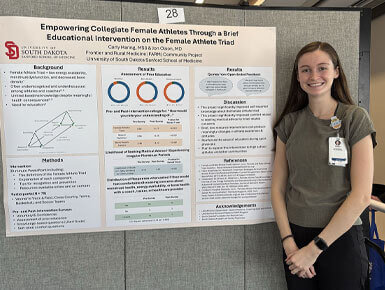
Other students take their projects to the national level, with Gerberding and Smith presenting at the National Rural Health Association Annual Health Conference in Georgia. A manuscript on Goetz’s project is currently under consideration in a dermatology journal.
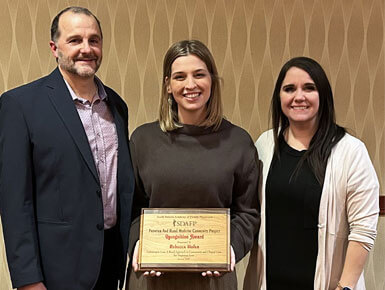
Additionally, each year a single project is chosen for the Outstanding Community Project Award, an honor presented by the South Dakota Academy of Family Physicians. For Wickersham, the key to a standout project is a mixture of pragmatism and passion.
“Try to find a balance of something that will have meaning for and make a difference to your community, but that you are also passionate about,” he advises. “When a student truly puts effort into their project, it really shines through.”
Growing Good Neighbors
Part of the process for all students is planting the seed for the next cohort. For many students, sustainability is the goal, and students have the opportunity to expand upon or carry on projects from previous years.
“My hope is that many of the projects will be picked up by community members or incoming students and continued indefinitely,” Wickersham says.
For Emily Kassing, a Class of 2028 member just starting her FARM rotation in Vermillion, the community project is a chance to continue existing efforts while creating something that can endure beyond her time at the site.
“I hope to leave the community better than I found it in some way,” she expresses. “I really like Vermillion, and it’s important to me to do something, both through clinical training and the community project, to serve the people who make Vermillion what it is.”
For her, medicine is more than just prescriptions in the clinic, it’s about promoting healthy and sustainable lifestyle changes, like increasing physical activity and improving diet.
“In the clinic, we try to treat medical illnesses but I’m hoping the community project helps me explore ways to implement more primary and secondary intervention,” she says. “I hope, through the process of this project, that we can show how modifying ‘non-medical’ factors for patients can help with medical outcomes.”
Overall, the Community Project Initiative exists at the intersection of academic research, community engagement and compassion. Through innovative approaches to care and a commitment to health equity, FARM students build resilience and creativity that will shape their future as leaders and healthcare providers.
“Outside of the context of medicine, I think it’s a great way to be a good neighbor–looking at the space and people around you and asking yourself: ‘What can I do to help?’” Kassing says. “I’m excited to develop clinical, public health and civic skills through service.”
You May Also Like

USD’s Master of Public Health Program Achieves Reaccreditation
The University of South Dakota and South Dakota State University’s joint Master of Public Health (MPH) program has been granted reaccreditation for a seven-year term, the maximum given, by the Council on Education for Public Health (CEPH).

SPURA Students Present at 2026 Eastern South Dakota Undergraduate Research Symposium
Eight undergraduate researchers participating in the University of South Dakota’s Summer Program for Undergraduate Research in Addiction (SPURA) finished a productive summer of research by presenting their work at the 2026 Eastern South Dakota Undergraduate Research Symposium.

USD Knudson School of Law Alumni Honored With 2026 Unleash Your Legacy Awards
Two distinguished alumni of the University of South Dakota Knudson School of Law were recognized as recipients of the 2026 Unleash Your Legacy Alumni Achievement Awards, celebrating their exceptional professional accomplishments, leadership and commitment to serving others.
